

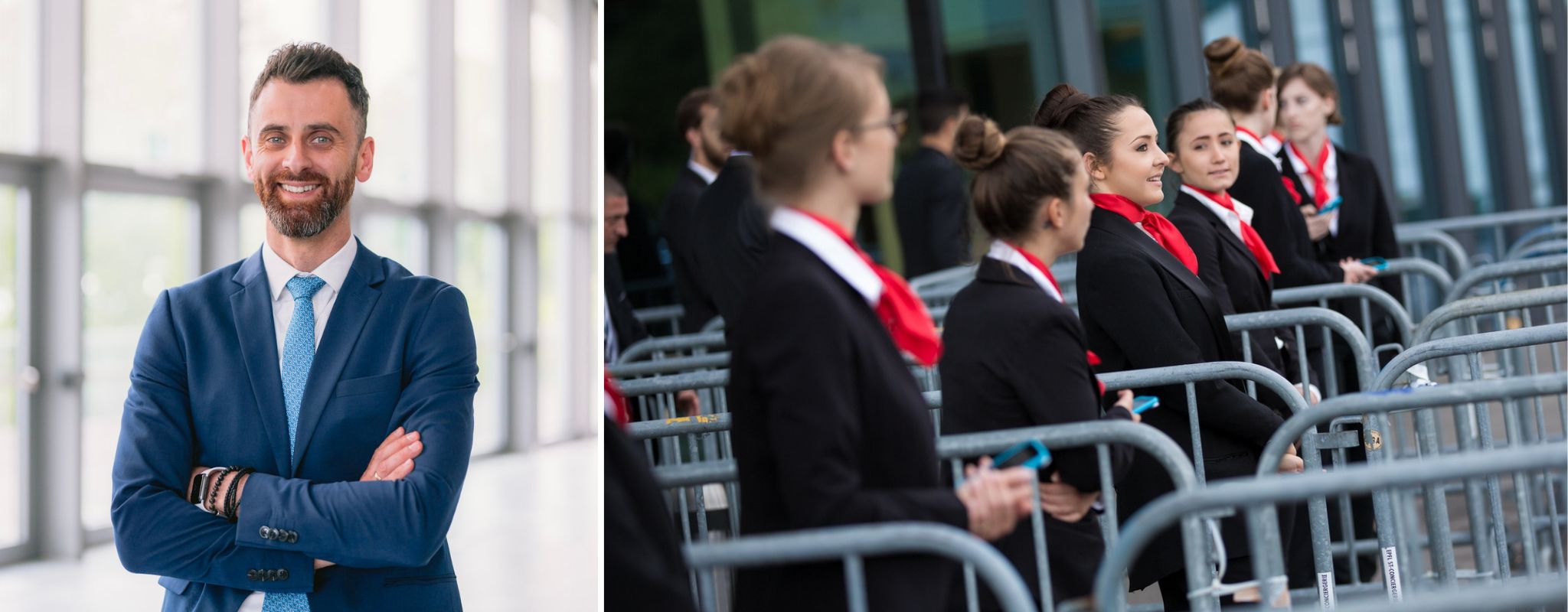

Some tragedies have the power to accelerate awareness. The recent events in Crans-Montana are a striking reminder that safety can never be taken for granted, even in environments widely regarded as secure. In professional venues dedicated to hosting events, this reality has long been part of everyday operations. Convention centres, cultural institutions and multifunctional venues operate within an ecosystem where risk management is an integral part of daily planning. In Switzerland, however, these issues are not addressed only in times of crisis. They are built upon a strong foundation: rigorous standards, a culture of anticipation, close coordination between stakeholders and a strong sense of responsibility. This approach contributes significantly to the country’s reputation for reliability, precision and security. But how does this culture translate into day-to-day operations? To gain a better understanding, we spoke with Lutfi Sakiri, Head of Security at the SwissTech Convention Center, located on the EPFL campus in Lausanne.
Safety Must Remain Invisible, Yet Essential
In event venues, security should never interfere with the attendee experience. This is precisely the philosophy embraced at the SwissTech Convention Center. “EPFL is a vibrant, international and open campus,” explains Lutfi Sakiri. “Our role is to ensure that this openness can thrive within a fully secure environment.”Here, as in many major infrastructures, security is not simply a matter of rules or technical systems. It is part of a broader approach, designed to facilitate activities rather than restrict them.“Security should enable events to take place under the best possible conditions, without ever becoming intrusive,” he adds.
Anticipating the Unpredictable Has Become the New Standard
Event security is evolving rapidly. “We operate in an increasingly complex environment,” says Lutfi Sakiri. “Social tensions, spontaneous mobilisations and reputational challenges can now directly affect an event.” The international context also plays a significant role.“Geopolitical developments abroad can have local repercussions, including here in Switzerland. This requires constant monitoring and the ability to adapt quickly.” As a result, every event hosted in this type of venue is subject to a dedicated risk assessment, covering attendee flows, participant profiles and potential risk scenarios. Nothing is left to chance. At the same time, organisers’ expectations continue to evolve. Events are becoming increasingly immersive, ambitious and highly visible, requiring greater levels of security while maintaining seamless operations and discretion. This work relies on close collaboration between organisers, technical teams and emergency services, within a framework of continuous coordination.
Finding the Right Balance: Maximum Security, Minimal Impact
Today, the challenge for event venues is clear: enhancing security without adding complexity. Attendees expect a safe environment without necessarily noticing the measures in place. This expectation is reshaping security strategies across the industry. “The security of tomorrow will be less visible, yet even more present,” concludes Lutfi Sakiri.
This delicate balance, shared by leading event venues worldwide, highlights an often-overlooked reality: when everything appears to run smoothly, security is already at work behind the scenes.